


Cranial Facial Release in Tomball
Cranial Facial Release in Tomball, TX — a specialized endonasal technique that gently mobilizes the bones of the skull and face for sinus and headache concerns.
Bluebonnet Chiropractic
Cranial Facial Release in Tomball

Written & medically reviewed by Dr. Elizabeth Kincaid, DC Owner & Chiropractor
Cranial Facial Release (CFR) is a specialized endonasal technique performed by a specially trained provider in which a tiny balloon is briefly inflated in the nasal passages to gently encourage mobility in the bones of the skull and face. Dr. Elizabeth Kincaid uses CFR as one option among several for selected patients in Tomball and northwest Houston who are dealing with sinus congestion, breathing difficulty, or certain headache patterns — always after a thorough intake to confirm it's appropriate for you.


How it works
What to expect with cranial facial release
- Step 1
Intake and screening
We review your health history in detail, ask about sinus, breathing, and headache patterns, and screen for any contraindications before recommending CFR.
- Step 2
A plain-English explanation
If CFR is appropriate, we walk you through exactly what will happen, what you may feel, and where it fits in your overall care plan — no surprises.
- Step 3
The technique itself
A tiny balloon is briefly inflated in the nasal passage, producing a gentle mobilization that lasts only seconds. Most patients tolerate it well and notice an immediate sense of openness in the nasal airway.
Why patients choose it
Benefits of cranial facial release
May improve nasal airflow and reduce sinus congestion
Can be part of a broader plan for certain headache and migraine patterns
Non-surgical — no incisions, no anesthesia, no downtime
Quick — each application takes only a few seconds
Performed by a specially trained provider with a detailed intake first
Integrates naturally with chiropractic adjustments and other conservative care
The basics
About cranial facial release
The bones of the skull and face are not fused in adults — they meet at sutures and can lose normal mobility over time from trauma, chronic tension, or structural factors. CFR applies a brief, controlled force through the nasal passages using a small finger-cot balloon, aiming to restore micro-movement in these cranial structures. The procedure takes only seconds per pass and is performed in a clinical setting.
CFR is not a cure-all, and not everyone is a candidate. We screen for contraindications before recommending it, and we're straightforward about the evidence — the technique has a long clinical history but limited large-scale clinical trials, so we describe what it may help with rather than making broad claims. For the right patient it can be a meaningful part of a broader care plan.

New Patient Special
Your first visit for just $57
We are running a new patient special for $57 on your first appointment! No promo code is needed to take advantage, just need to schedule!
New Patient Special is not valid on weekend appointments, full appointment rate applies

What is Cranial Facial Release?
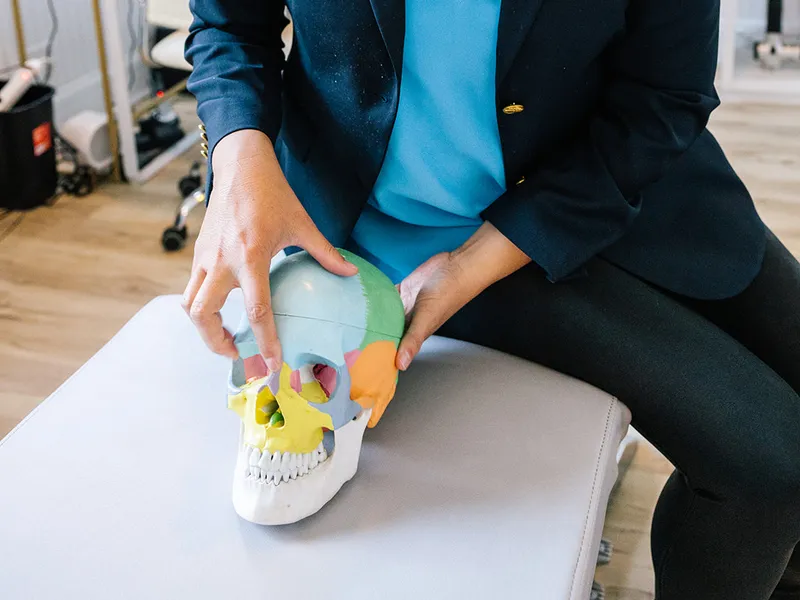
Cranial Facial Release (CFR) is a specialized endonasal technique that uses a very small balloon briefly inflated in the nasal passage to gently mobilize the bones of the skull and face. The procedure is based on the principle that the cranial and facial bones — though they feel solid — meet at flexible sutures that can lose normal mobility due to trauma, chronic tension, or structural factors.
CFR is not a mainstream chiropractic adjustment. It’s a separate technique requiring specific training, and Dr. Kincaid performs it only after a thorough intake to confirm you’re a suitable candidate. We’re straightforward about what the evidence says: there’s substantial clinical experience with the technique, and many patients report meaningful improvement in nasal airflow and related symptoms, but large-scale clinical trials are limited. We describe what it may help with honestly — not as a cure for everything.
What to expect
Your first step is an intake conversation, not the procedure itself. We review your health history, ask about your sinus, breathing, headache, or other concerns, and screen for any contraindications. If CFR looks like a good fit, we explain the procedure in plain English before proceeding.
When you’re ready, Dr. Kincaid gently guides a small finger-cot balloon into the nasal passage and briefly inflates it — the entire active phase lasts only a second or two. Most patients feel a moment of pressure, similar to what you’d feel jumping into a pool. There may be some watering of the eyes and a sensation of the nasal passages opening. You stay fully clothed and alert throughout; there’s no anesthesia and no downtime afterward.
CFR is typically done in a series of sessions rather than as a one-time treatment. After your intake, Dr. Kincaid recommends a specific number of sessions based on your situation, with a clear plan and honest expectations.
Who it helps
CFR may be a good option if you’re dealing with:
- Chronic sinus congestion or nasal obstruction that hasn’t responded to other approaches
- Breathing difficulty related to structural factors in the nasal passages
- Headache or migraine patterns with a sinus or facial component
- Vertigo or inner-ear concerns linked to cranial tension
- TMJ or jaw symptoms that involve the surrounding facial structures
It’s not for everyone. Active sinus infection, recent nasal surgery, certain anatomical variations, or specific health conditions may make CFR unsuitable — that’s exactly what the intake screen is designed to catch. If CFR isn’t right for you, we’ll say so and discuss other options that may be a better fit.
Why choose Bluebonnet Chiropractic
At our Tomball office, Dr. Elizabeth Kincaid brings a deep background in cranial work — including certification as a CranioSacral Therapist and advanced training in evaluating and adjusting the pediatric cranium — along with a straightforward approach to care. We don’t recommend CFR (or any technique) until we’ve done the intake work to confirm it’s appropriate for you — and we’re honest about both the benefits and the limitations.
CFR works best as part of a broader care plan alongside chiropractic adjustments and other conservative therapies tailored to your specific concerns. Whether you’re from Tomball, Magnolia, Cypress, Spring, or The Woodlands, we’d be glad to sit down with you, review what’s going on, and give you an honest assessment.
Ready to find out if CFR is right for you? Meet with Dr. Kincaid or contact us to schedule a consultation.
What it helps
Conditions we treat with cranial facial release
What is Cranial Facial Release?+
CFR is a specialized endonasal technique in which a small balloon is briefly inflated in the nasal passage to gently mobilize the bones of the skull and face. It's performed by a specially trained provider and used as part of a broader care plan for selected patients.
Does Cranial Facial Release hurt?+
Most patients describe a momentary pressure sensation in the nose and sinuses — a bit like jumping into a pool. It lasts only a second or two, and most people tolerate it well. We talk through what to expect before we begin.
How many sessions does CFR take?+
It varies. After your intake, Dr. Kincaid will recommend a specific number of sessions based on what you're dealing with. CFR is typically done in a series, not as a one-time procedure.
Is Cranial Facial Release safe?+
For appropriate candidates it has a strong safety record in clinical practice. We screen every patient beforehand, and there are some situations — recent nasal surgery, certain structural factors, active sinus infection — where we would not perform it or would refer you elsewhere.
Who is a good candidate for CFR?+
Patients dealing with chronic sinus congestion, nasal obstruction, breathing difficulty, or headache patterns that haven't responded well to other conservative care are often the ones we consider. A thorough intake is the first step to see if it's right for you.
Will my insurance cover Cranial Facial Release?+
Coverage for CFR varies by plan. If you have questions about cost or coverage, call our office before your first visit and we'll talk it through with you.
Is Cranial Facial Release the same as chiropractic adjustment?+
No — CFR is a distinct, endonasal technique rather than a spinal adjustment. Dr. Kincaid is trained in both, and they're sometimes used together as part of a comprehensive plan.
Can CFR help with TMJ or jaw symptoms?+
The cranial and facial structures addressed by CFR are adjacent to the jaw joint, and some patients with TMJ discomfort find it helpful as part of their care. We'll evaluate your specific situation during your intake.
Does CFR require any special preparation?+
Very little. If there is anything to avoid beforehand — such as nasal decongestants on the day of your session so we can assess your baseline — Dr. Kincaid will let you know when the session is scheduled. Beyond that, there's no special preparation needed.
Where can I get Cranial Facial Release near Tomball?+
Dr. Elizabeth Kincaid offers CFR at our Tomball office, serving patients from Magnolia, Cypress, Spring, and The Woodlands. Request a consultation and we'll determine whether it's the right fit for you.
Explore more
Related services
Patient reviews